2048 Online
Slide tiles with arrow keys or buttons. Matching numbers merge into bigger tiles — keep going until you hit 2048.
Merge tiles to reach 2048.
Slide in any direction
Use arrow keys or the on-screen D-pad to slide all tiles in one direction at once.
Merge matching tiles
When two tiles with the same number collide they merge into one tile with their sum.
Reach 2048
Keep merging until you create a tile with the number 2048 to achieve the goal.
2048: The Indie Game That Took the World by Storm
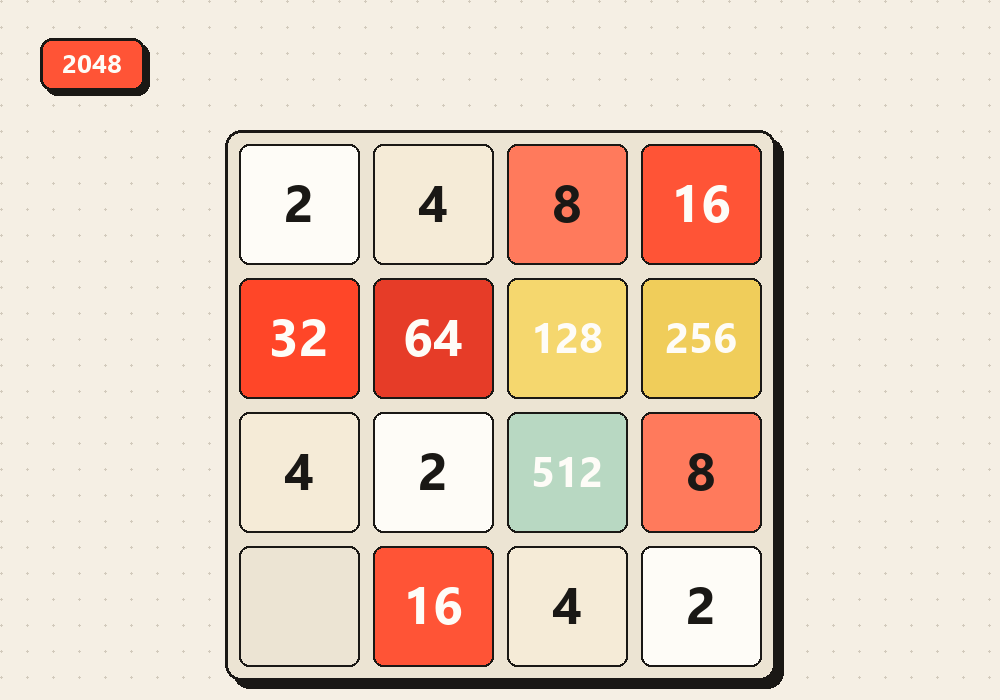
2048 was created by Italian web developer Gabriele Cirulli and released in March 2014 as a free, open-source project on GitHub. Within weeks of its release the game became a viral sensation, being played over 10 million times in its first week alone. Cirulli wrote it in a single weekend as a personal project — one of the most striking examples in gaming history of a solo developer with no budget creating something that reached a global audience overnight.
The game was inspired by Threes!, a paid mobile puzzle game released two months earlier that used similar tile-merging mechanics. Cirulli's open-source version made the concept freely accessible to the world and spawned hundreds of variations. 2048 is notable for being mathematically analyzable: the theoretical maximum tile achievable is 131,072, though reaching even the 2048 tile requires sustained strategic focus. The minimum score needed to produce the 2048 tile is exactly 18,368 points.
2048 has also found a home in computer science education as an AI benchmark. Student programs that play 2048 optimally use search algorithms and heuristic functions to look many moves ahead — similar to chess engines. Some implementations reach the 4096 or even 8192 tile reliably using techniques like expectimax search and tile-weighting heuristics. This makes 2048 one of the few casual browser games that has inspired genuine academic research.
Reach 2048 with the corner strategy.
Keep your highest tile in a corner
The single most important 2048 strategy is anchoring your largest tile in one corner — ideally bottom-right — and never letting it move away from there. Build everything else around protecting and growing that tile.
Move in only two or three directions
Committing to a consistent two-direction flow (mostly left and down, for example) keeps your tile arrangement orderly. Random sliding in all four directions creates chaos that is very difficult to recover from.
Build a descending staircase
The ideal board state has tiles decreasing in value from your anchor corner outward, like a staircase. The second-highest tile sits next to the highest, the third next to the second, and so on — creating a clean merge chain.
Don't chase 2-tiles
New 2-tiles appear after every move. Wasting slides chasing them to merge is rarely worth the disruption. Focus on high-value merges and let 2-tiles accumulate until they fall naturally into your flow pattern.
Common questions about 2048.
Is reaching 2048 guaranteed with good strategy?
No, but the probability is much higher with the corner strategy than with random play. The game occasionally spawns 4-tiles instead of 2-tiles (about 10% of the time), and an unlucky streak can disrupt even an ideal board. Skilled players reach 2048 in the large majority of their games.
What comes after 2048?
The game continues past the 2048 tile if you choose to keep playing. The next milestones are 4096, 8192, and 16384. Reaching 4096 requires the same strategy but with significantly tighter tile management. Getting to 8192 consistently is considered an excellent achievement.
When does the game end?
The game ends when the board is completely full and no two adjacent tiles share the same value — meaning no merges are possible and no new tile can appear. This is the game-over state. Your final score and best score are displayed at the top.
Can I use keyboard controls?
Yes. On desktop, the four arrow keys control tile direction. On mobile or without a keyboard, the on-screen D-pad below the board provides the same four directional controls.