Word Scramble
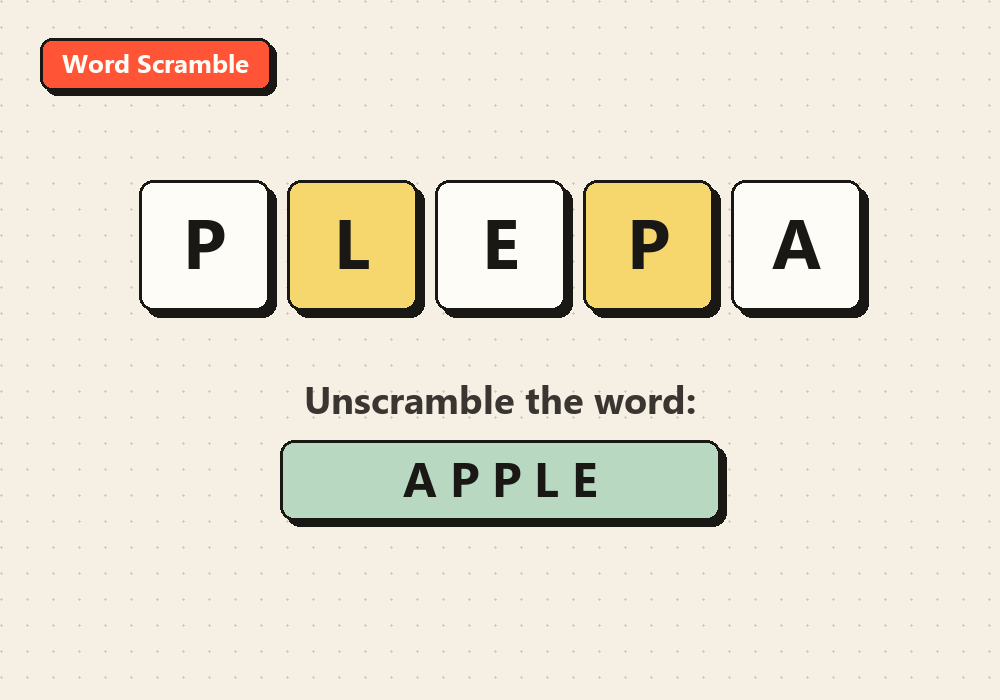
Unscramble the letters to find the hidden word. Each correct answer adds to your score.
Unscramble each word to score.
Read the scramble
Study the shuffled letters displayed above the input field.
Type your answer
Type the correctly spelled word and press Submit or Enter.
Skip if stuck
Use the Skip button to move on without penalty if a word has you stumped.
Word Scramble: A History of Letter Puzzles
Word scramble puzzles have appeared in newspapers, puzzle books, and school workbooks for over a hundred years. The syndicated "Jumble" puzzle column, first published in 1954 by Martin Naydel, introduced scrambled words to a mass newspaper audience and still runs in hundreds of papers today. Teachers have long used word scrambles to reinforce correct spelling, build vocabulary, and help students recognize the internal letter patterns of words they know but sometimes misspell.
The cognitive skill at work when solving a word scramble is called orthographic pattern recognition — your brain's learned ability to detect and complete familiar letter sequences. Proficient readers process words partly by overall shape and common letter groupings rather than decoding them letter-by-letter. This is why skilled word scramble players can solve many puzzles almost instantly: the familiar pattern clicks into place before conscious analysis even begins.
Word scramble is also an effective vocabulary-building and spelling reinforcement tool. When you struggle to identify a scrambled version of a word you actually know, it strengthens the connection between those specific letters and the word's meaning. Correctly solving a word you were unsure of frequently cements the correct spelling in memory far more reliably than simply reading it on a page.
Unscramble faster with these techniques.
Look for common endings first
English words very often end in -ing, -tion, -ed, -er, -ly, -ness, or -ful. Spotting these letter groups in the scramble and attaching them to the end narrows the problem to just the remaining letters.
Count vowels and consonants
Most English words have roughly one vowel per two letters. Counting the vowels in a scramble gives you a frame for where they can plausibly sit and how many consonant clusters to expect.
Build from recognizable chunks
Rather than trying every letter permutation, look for two- or three-letter roots you recognize — "str", "th", "qu", "ing" — and build the rest of the word around them. This chunk-first approach is much faster than random trial and error.
Use high-frequency starting letters
The most common first letters in English words are S, C, P, and A. If the scramble contains one of these letters and the rest of the pattern fits a recognizable word, try it at the start first.
Common questions about Word Scramble.
Can I skip a word I cannot solve?
Yes. The Skip button lets you move to the next word at any time without any penalty to your score. Use it freely if you are stuck, and try to identify which letter patterns tripped you up so you can recognize them faster in future rounds.
Where do the words come from?
Words are drawn from a curated list of common English vocabulary — familiar enough to be recognizable but not so simple that every answer is trivial. The order in which they appear is randomized each game, so repeated plays always feel fresh.
Is Word Scramble good for language learning?
Yes, especially for spelling practice. Reconstructing a scrambled word reinforces how those specific letters are correctly ordered — a stronger memory encoding method than passively reading the word. It is widely used in ELL (English Language Learner) classrooms for exactly this reason.
Is it case-sensitive?
No. You can type your answer in uppercase or lowercase — the game accepts either. The scrambled letters displayed are always uppercase for clarity, but your typed answer can be in any case.