Memory Match Game
Flip two cards at a time and match all eight pairs. The fewer moves you use, the better your score.
Train your memory one pair at a time.
Flip two cards
Choose any two hidden cards to reveal their letters.
Remember positions
If they do not match, they flip back after a short pause.
Beat your best
Your best move count is saved in this browser.
Memory Match: A Classic Card Game
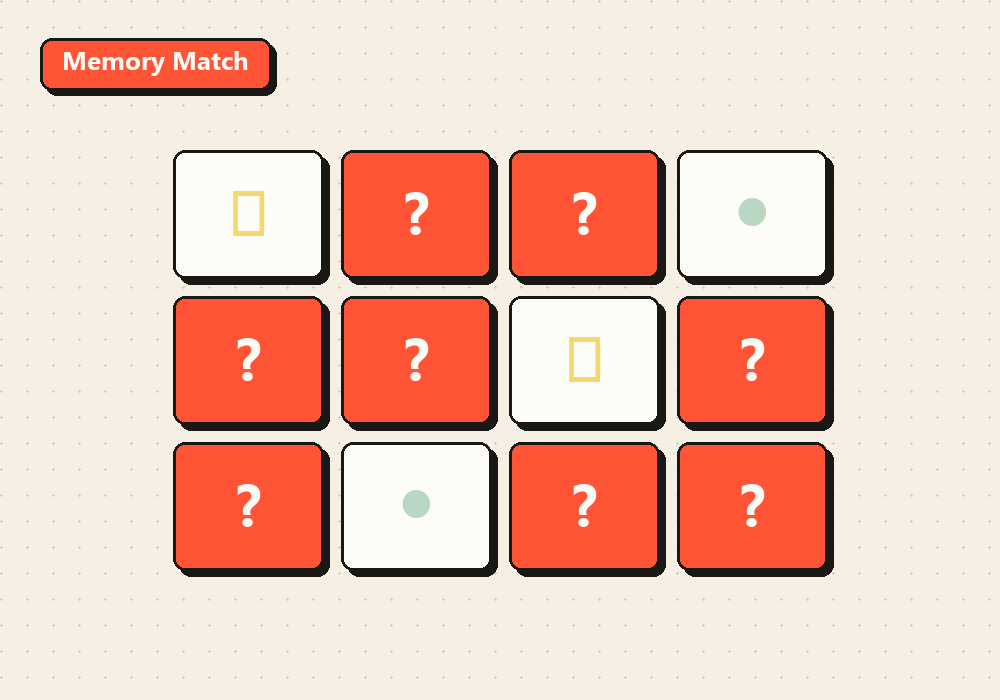
Memory Match — also called Concentration, Shinkei-suijaku, or Pexeso depending on the country — has been a fixture of childhood development for over a century. It began as a physical card game and became especially popular through the mid-20th century when it was packaged as a children's toy. The premise is elegantly simple: a set of matched pairs is shuffled and placed face-down, and players take turns flipping two at a time, trying to find identical matches.
Cognitive scientists have long studied Memory Match because it directly exercises working memory and spatial recall. Each flip forces you to encode the position and identity of a card, and the longer the game takes, the more cards must be held in mind simultaneously. Studies suggest that regular card memory games can help maintain and improve short-term memory capacity across all age groups — from children building foundational recall skills to adults keeping their minds sharp.
Our browser version uses eight pairs of letters across a 4×4 grid. Your move count is tracked, and your best score is saved locally in your browser so you can try to beat yourself across sessions. There is no time pressure, so you can take your time and focus purely on improving recall.
Fewer moves, better score.
Work through rows systematically
Rather than flipping random cards, move row by row across the grid. A systematic scan builds a mental map faster than jumping around and helps you locate previously seen cards reliably.
Use spatial anchors
Attach a location cue to each card — "the A is in the top-left corner." Turning memory into spatial positions makes it far easier to recall under the slight pressure of tracking a move count.
Use one known card per turn
Each time you flip, try to use at least one card whose partner you already know. When you flip two unknowns and they don't match, you still gain information — remember both new positions.
Don't rush the first few moves
Early in the game, resist the urge to guess. Deliberate flips at the start gather the location data you will need to clear the board quickly in the final rounds.
Common questions about Memory Match.
How is my best score measured?
Your best score is the lowest number of moves used to match all eight pairs. It is stored in your browser's local storage, so it persists between sessions on the same device. Playing in a private or incognito window will clear it when the window closes.
Does Memory Match actually improve memory?
Yes — regular play can sharpen short-term visual recall and spatial memory. Psychologists frequently use concentration-style tasks in memory research. While no single game is a guaranteed brain trainer, the encoding and retrieval processes practiced here mirror the same circuits used in everyday memory tasks.
Are the card positions the same every game?
No. Cards are shuffled randomly at the start of each game, so every run is a fresh challenge. This prevents memorizing a fixed layout and keeps the game genuinely engaging across many sessions.
Is this suitable for children?
Yes — Memory Match is one of the most widely recommended games for children aged 3 and up. It builds concentration, visual recognition, and short-term memory in a low-pressure, engaging format.