Connect Four Online
Drop your red discs into the grid and connect four in a row before the computer connects yellow.
Four discs in a row wins.
Drop a disc
Choose a column and your disc falls to the lowest open space.
Watch the computer
The computer looks for wins and blocks obvious threats.
Connect four
Win horizontally, vertically, or diagonally.
Connect Four: From Classic Toy to Solved Game
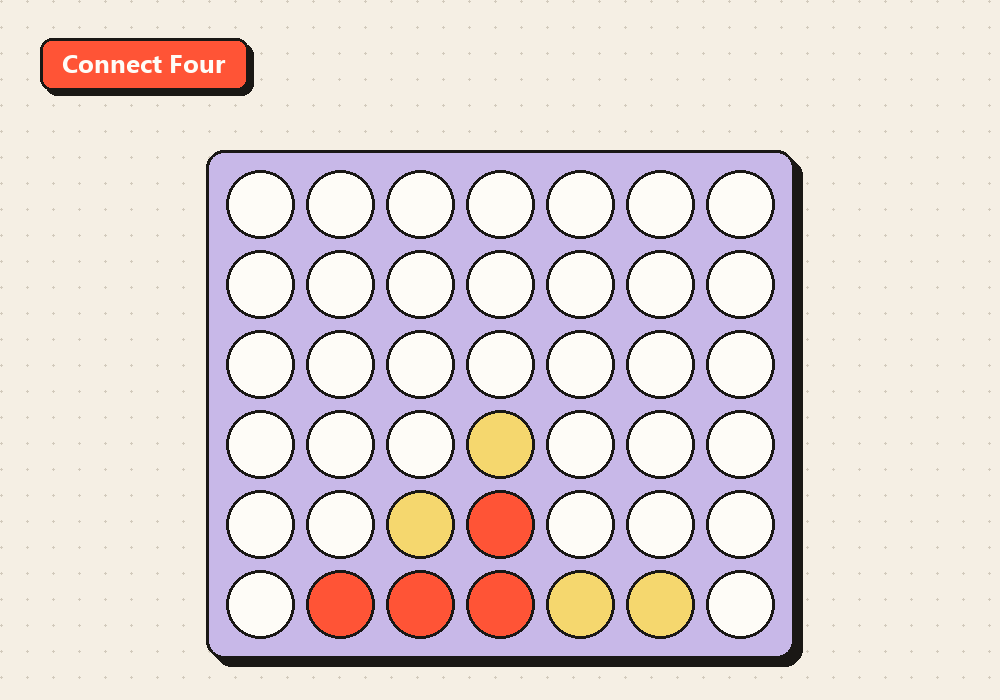
Connect Four was patented by Howard Wexler and Ned Strongin in 1974 and first sold by Milton Bradley that same year. The game became an instant success, selling over 40 million units worldwide in its first few decades. The vertical falling-disc format — in which each piece falls to the lowest open space in its column — was a genuinely novel mechanic that created strategic depth far beyond what the simple rules implied.
In 1988, mathematicians James D. Allen and Victor Allis independently proved that Connect Four is a "solved game" — meaning the first player can always win with perfect play. The solution requires starting in the center column. This made Connect Four a landmark in combinatorial game theory. In practice, though, optimal play requires evaluating over four trillion possible game states — well beyond human calculation — so most games between real players are decided by tactical skill rather than theoretical perfection.
Against a computer opponent that does not play perfect minimax, Connect Four rewards positional thinking, threat stacking, and the ability to spot forced win sequences. Understanding how diagonal threats interact with horizontal ones is the key skill separating average players from consistent winners.
Dominate the grid with better positioning.
Start in the center column
Column 4 (the middle) gives access to more winning lines than any other column. Every game against a strong opponent should begin here. It is not just tradition — it is the mathematically proven first move of perfect play.
Build threats in the lower rows
Discs placed high in the grid are often blocked by running out of space. Create your winning threats in rows 2–4 where there is room to stack discs above the threat before the board fills.
Set up a double threat (fork)
A fork creates two simultaneous winning lines. The opponent can only block one, so the other wins. Practice placing discs so that your next turn wins in two different directions at once — this is the most reliable winning technique.
Scan all four directions
The most common source of surprise losses is a building diagonal threat that goes unnoticed. After every move, quickly scan horizontal, vertical, and both diagonal directions for the computer's threats before choosing your column.
Common questions about Connect Four.
Can I win every game with the right strategy?
With optimal play, the first player can always win. However, the computer here uses a heuristic strategy that blocks obvious threats and prefers central columns. You can beat it consistently with double-threat setups. True perfect play requires computer-level analysis of millions of positions.
What is the board size?
The board is the standard 7 columns by 6 rows as used in the original Milton Bradley game. You are always the red player and you move first, which gives a slight theoretical advantage.
Why do I sometimes lose to a quick diagonal?
Diagonal threats are the most common source of quick defeats. The human eye tends to focus on horizontal lines, making diagonals easy to overlook. Getting into the habit of scanning all four directions after every move dramatically reduces surprise losses.
Is Connect Four appropriate for children?
Yes — Connect Four is recommended for ages 6 and up. It is an excellent game for teaching forward-planning, pattern recognition, and logical thinking. The rules are simple enough for young children but the strategy is deep enough to challenge adults.