Simon Says Online
Watch the flashing color sequence and repeat it. Each level adds one more color to remember.
Watch, remember, and repeat.
Watch the sequence
Each color pad flashes in a specific order. Observe carefully before touching anything.
Repeat the pattern
Press the color pads in the exact same order as the sequence you just watched.
Level up
Each correct repetition adds one more color to the sequence for the next round.
Simon Says: The Electronic Memory Game
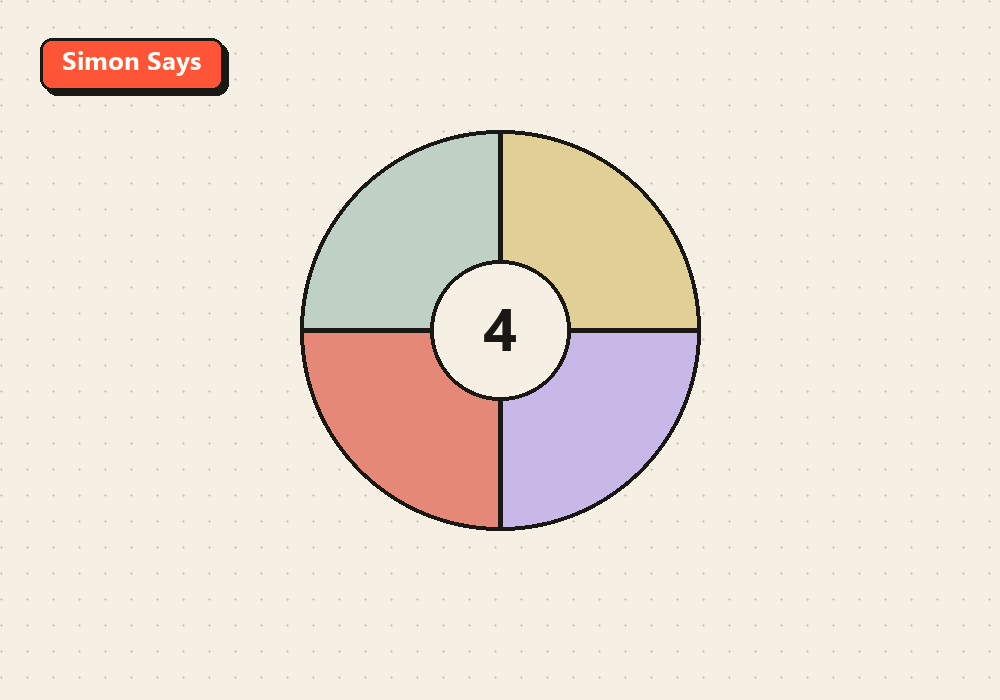
The electronic Simon game was created by Ralph Baer and Howard Morrison and commercially released by Milton Bradley in 1978. The toy consists of four colored buttons that light up and emit tones in sequences the player must repeat. It became one of the defining toys of its generation, selling millions of units and being named one of Time magazine's top 100 toys of the 20th century. For many players, Simon was their first experience with a game that directly tested and trained memory in a structured, progressive way.
The game specifically targets sequential memory — the ability to store and recall an ordered list of items. Unlike spatial memory, which is used in games like Memory Match, or semantic memory used in Hangman, sequential memory is its own distinct neurological system and can be independently trained. Musicians, dancers, competitive athletes, surgeons, and memory sports competitors all rely heavily on this type of ordered recall in their work. Regular Simon practice builds exactly the same capacity.
Neuroscience research has shown that the original Simon game engages both auditory and visual memory simultaneously when lights and sounds are synchronized. Our browser version focuses on visual sequence recall using the color flash pattern, giving players a clear measurement of how many sequential items they can hold reliably in working memory — and a motivating challenge to push that number higher with practice.
Reach higher levels with better memory technique.
Watch the full sequence first
It is tempting to start pressing buttons as soon as the first few colors flash. Resist this — always watch the complete sequence before responding. Premature input breaks concentration and leads to errors on the later colors.
Group colors into chunks
After the sequence reaches four or five colors, group adjacent steps into pairs: "green-red" becomes one unit, then "blue-yellow" another. Chunking is the most powerful technique in memory science for extending sequence recall beyond seven items.
Verbalize the pattern
Assigning a syllable or spoken word to each color — "ba, da, da, ba" — converts the visual pattern into an auditory memory as well, giving you two distinct memory channels instead of one. Most people find this dramatically extends their reliable sequence length.
Track your personal ceiling
Most people can reliably recall sequences of 7 items plus or minus 2 (Miller's Law). Simon gives you a concrete, gamified way to find and push your personal working memory ceiling with regular practice.
Common questions about Simon Says.
What level do most people reach?
Casual players typically reach levels 5–10 before making a mistake. Practiced players with good chunking technique regularly hit levels 15–20. The world record for the original Simon electronic game exceeds 30 levels, achieved through intensive practice and deliberate memory strategies.
Does the game use sound?
The current browser version relies on the visual flash of each colored pad rather than audio tones. This makes it fully accessible without headphones and usable in quiet environments like offices or classrooms.
Is Simon Says appropriate for children?
Yes. The physical toy is rated for ages 3 and up. Our browser version is equally appropriate for children, and the gradual one-color-at-a-time progression makes it a confidence-building exercise that rewards patience and sustained focus.
Does practicing Simon Says actually improve memory?
Sequential memory can be trained and improves with deliberate practice. The chunking techniques used by Simon players are the same ones used by competitive memory athletes. While Simon alone won't transform your overall memory, regular practice of sequential recall tasks does strengthen the specific circuits involved.