Rock Paper Scissors
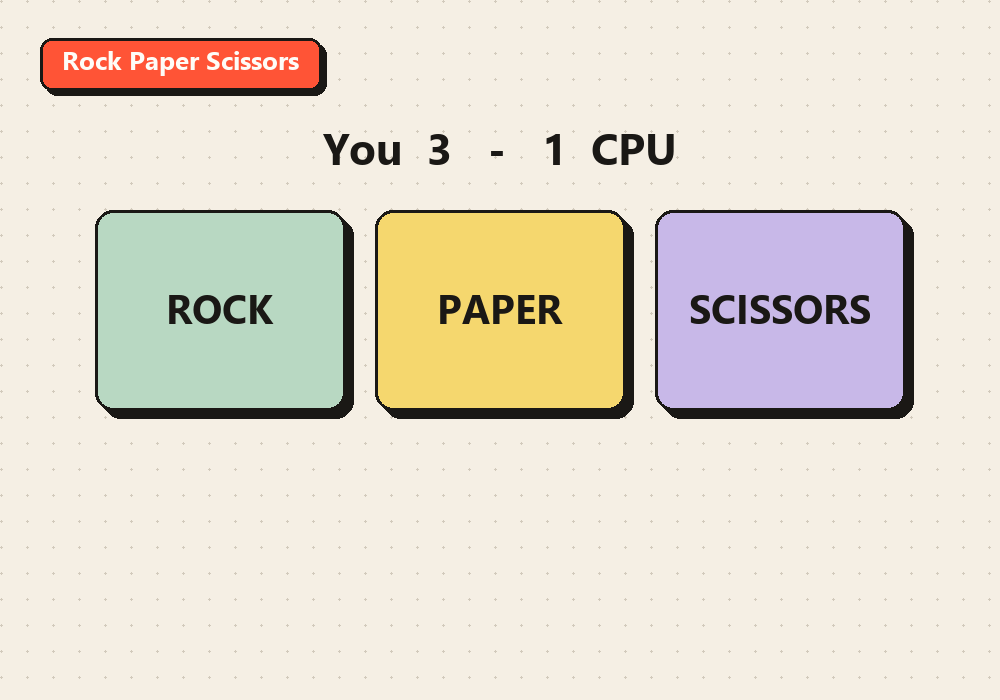
Play a fast round against the computer. Rock beats scissors, scissors beats paper, and paper beats rock.
Three choices, one winner.
Rock
Rock beats scissors but loses to paper.
Paper
Paper beats rock but loses to scissors.
Scissors
Scissors beats paper but loses to rock.
Rock Paper Scissors: History and Psychology
Rock Paper Scissors is one of the most universally played hand games in the world. Versions have been documented across Asia, Europe, and the Americas for centuries. The game is known in Japan as jan-ken-pon, where it has served both as competition and as a traditional decision-making tool. International Rock Paper Scissors championships — yes, they exist — draw dedicated competitors who study human psychology and behavioral patterns to build winning streaks.
What makes the game interesting beyond its simplicity is that while a computer opponent chooses randomly, human players rarely do. People exhibit strong biases in their choices, often repeating a winning throw or switching after a loss in predictable ways. Competitive players study opponent tendencies and exploit this psychology. Rock Paper Scissors has become a standard teaching example in game theory and behavioral economics, illustrating Nash equilibria and how rational actors can still behave predictably in repeated interactions.
The game is also a classic example of a non-transitive relationship in mathematics: Rock beats Scissors, Scissors beats Paper, Paper beats Rock — and the cycle never resolves into a clear hierarchy. This property has made it a useful model in everything from voting theory to evolutionary biology.
Win more rounds with these insights.
Against random: no throw wins more
Our computer picks randomly every round. In the long run, each of rock, paper, and scissors wins exactly one-third of the time. Focus on enjoying the streak rather than looking for patterns to exploit.
Against humans: open with paper
Studies of human behavior show that players — especially in their first round — slightly favor rock. Opening with paper gives a statistical edge in the very first move against a new human opponent.
Switch after your own win
Human players who just won often repeat their throw. Switching your throw after winning is a counter-intuitive but statistically sound tactic when playing live against a person rather than a computer.
Use it as a decision tool
Rock Paper Scissors was historically used as a fair, bias-free tie-breaker long before it was a competitive game. It is still one of the most reliable ways to make a quick, impartial decision between two people.
Common questions about Rock Paper Scissors.
How does the computer pick its throw?
The computer selects completely at random between rock, paper, and scissors on every single round — no pattern, no weighting, pure randomness. This means you cannot gain a statistical advantage over time, but it does make for a fair and unpredictable opponent.
Can I play multiple rounds in a row?
Yes. After each round the result is recorded in the win, tie, and loss tracker below the game, and you can keep playing as long as you like. Your running tally stays on screen until you refresh the page.
Why is it called Rock Paper Scissors in English?
The English name comes from the physical hand gestures: a closed fist for rock, a flat open hand for paper, and two spread fingers for scissors. The game spread from Asia to Europe and the Americas in the early 20th century, standardizing both the name and the rules along the way.