Typing Race
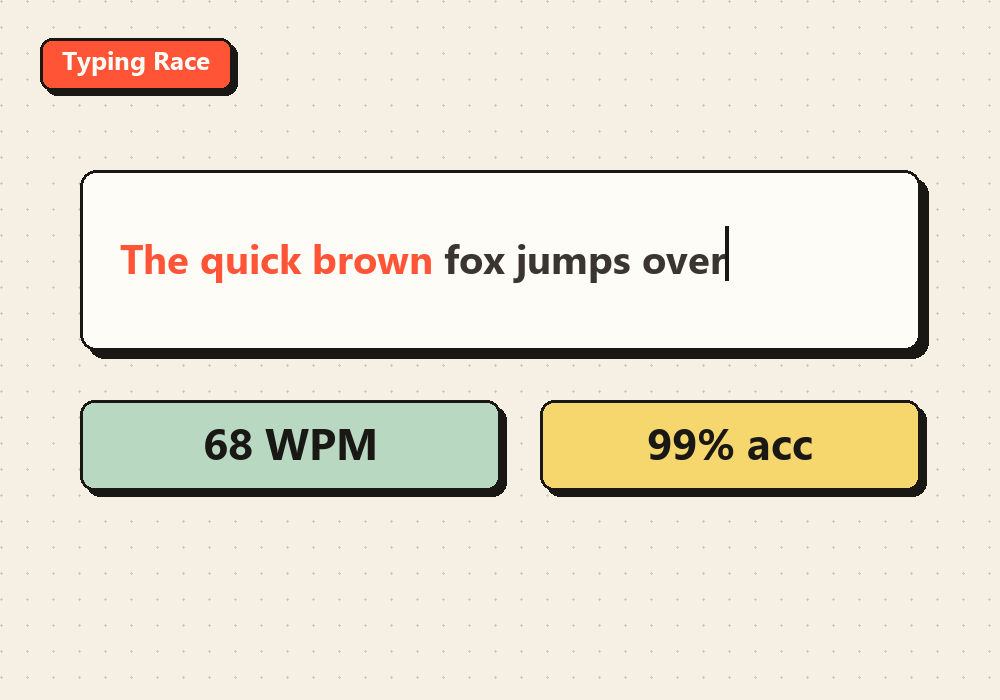
Type the sentence exactly and track your words per minute and accuracy as you go.
Type accurately and build your speed.
Press start
A typing prompt loads and your live WPM and accuracy tracking begins.
Type the prompt
Reproduce the displayed text exactly, including punctuation and capitalization.
See your stats
WPM and accuracy update live as you type. Complete the prompt to see your final result.
Typing Speed: A Skill Worth Developing
Touch typing — typing without looking at the keyboard — was developed alongside the typewriter in the late 19th century. Frank Edward McGurrin is credited with teaching the first systematic touch-typing method in 1888, and timed typing competitions became popular in the early 20th century as a professional credential. Court reporters, secretaries, and telegraph operators all competed on speed and accuracy. Today, typing speed and accuracy remain valued professional skills in medical transcription, legal work, software development, and any field that involves sustained computer use.
Words per minute (WPM) is the standard measure of typing speed. The average adult types between 35 and 45 WPM. Proficient professional typists historically targeted 70–90 WPM. Competitive typists and many programmers regularly exceed 100–120 WPM. Accuracy is equally important: 98% accuracy at 70 WPM produces fewer real errors than 94% accuracy at 90 WPM — which matters significantly in professional work where corrections cost time and focus.
Research on typing skill improvement consistently shows that timed, goal-oriented practice with immediate feedback is one of the most effective methods for raising both speed and accuracy. The Typing Race game provides exactly this: a measured text prompt, live WPM and accuracy tracking, and the ability to immediately restart and try again. Each session is a concrete data point in your ongoing improvement.
Type faster with better technique.
Prioritize accuracy over speed
It is counterintuitive, but typing slowly and accurately builds faster long-term habits than rushing with errors. Errors require correction which costs more time than careful keystrokes. Your accuracy percentage is the most important metric to optimize first.
Keep your eyes on the prompt
Trained typists trust muscle memory and focus on the text being typed rather than their fingers. Looking at the keyboard breaks your rhythm and dramatically reduces speed. Build the habit of watching the prompt as you type.
Use the home row position
The home row (ASDF on the left, JKL; on the right) is where fingers return between keystrokes. Using the correct finger for each key, learned through proper touch-typing technique, is more efficient than hunting for each key individually.
Practice difficult combinations deliberately
Most typists have one or two letter combinations they consistently struggle with. If you notice you always pause or mistype certain sequences, deliberately practice them in isolation rather than hoping general practice will fix them naturally.
Common questions about Typing Race.
How is WPM calculated?
Words per minute is calculated as the total number of characters typed divided by 5 (the standard word length used in typing measurement), divided by the elapsed time in minutes. So 250 characters typed in one minute equals exactly 50 WPM regardless of how long the actual words were.
What is a good WPM score?
Average adults type between 35 and 45 WPM. Proficient typists reach 65–80 WPM. Scores above 100 WPM are excellent and achieved by fewer than 5% of typists. If you are below 40 WPM, regular daily practice sessions will produce noticeable improvement within a few weeks.
Can Typing Race replace dedicated typing software?
Typing Race is a fast benchmarking and practice tool rather than a structured typing curriculum. For learning touch typing from scratch, dedicated typing tutors that teach finger placement systematically are more effective. For regular speed practice and benchmarking once you already know touch typing, this is a frictionless and convenient option.
What prompts are used in the game?
Prompts are short sentences containing a variety of common letter combinations, punctuation, and word lengths. They are designed to give a representative sample of everyday typing demands rather than focusing on unusual or difficult edge cases.